Resource Center

Carbon Accounting Resource Center

Explore practical guidance on Product Carbon Footprint, Scope 3, LCA methods, supplier collaboration, and verification-ready carbon delivery.

Articles & Insights

Practical guides, regulatory breakdowns, and operating notes from the Climate Seal team.

CBAM and Chinese Companies: From Compliance Burden to Carbon Competitiveness - cover image
CBAM/CSRD/PEF/EPD/DPP Compliance
Featured

July 10, 2026

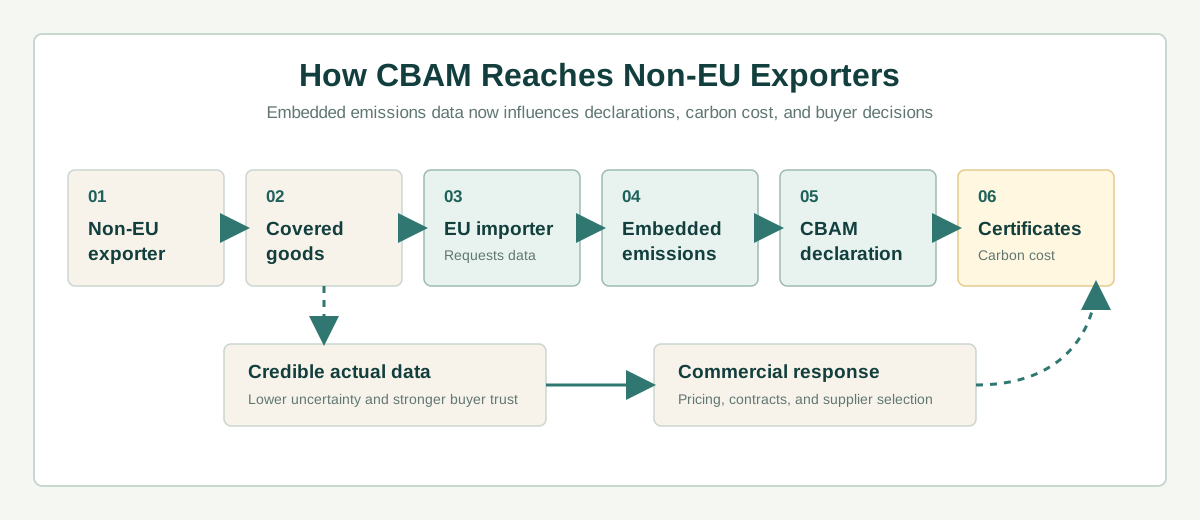
CBAM and Chinese Companies: From Compliance Burden to Carbon Competitiveness

CBAM is becoming a real trade, cost, data, and competitiveness issue for Chinese exporters. Here is how companies can turn compliance pressure into carbon competitiveness.

Open article
The Future of Product Carbon Labels: What Companies Should Prepare For - cover image
CBAM/CSRD/PEF/EPD/DPP Compliance
Featured

July 6, 2026

The Future of Product Carbon Labels: What Companies Should Prepare For

Product carbon labels are evolving from voluntary sustainability badges into evidence-based, digital, and verification-ready carbon data systems. Here is what companies should prepare for.

Open article
Understanding ISO 14067, PAS 2050 and the GHG Protocol Product Standard - cover image
PCF & LCA Methods
Featured

June 26, 2026

Understanding ISO 14067, PAS 2050 and the GHG Protocol Product Standard

A practical guide to ISO 14067, PAS 2050 and the GHG Protocol Product Standard: when each product carbon footprint framework is used, how boundaries work, and how to choose the right standard.

Open article
CBAM 2026: From Reporting Obligation to Real Carbon Cost - cover image
CBAM/CSRD/PEF/EPD/DPP Compliance
Featured

June 22, 2026

CBAM 2026: From Reporting Obligation to Real Carbon Cost

CBAM has entered its definitive regime. The first certificate price, the 50-tonne threshold, downstream expansion signals, and indirect-emissions policy work all point to one conclusion: embedded carbon is becoming a trade cost.

Open article
Stop Using Default Values: The Real Cost of CBAM — And a One-Time PCF Path - cover image
CBAM/CSRD/PEF/EPD/DPP Compliance
Featured

September 15, 2025

Stop Using Default Values: The Real Cost of CBAM — And a One-Time PCF Path

Default values aren't a shortcut under CBAM—they often raise tax, increase audit risk, and slow shipments. Here's a practical alternative: build a once-and-reusable product carbon footprint (PCF) model.

Open article
Product Carbon Footprint (PCF): Meaning, Methods & When You Need It - cover image
Getting Started
Featured

September 11, 2025

Product Carbon Footprint (PCF): Meaning, Methods & When You Need It

A practical PCF guide: what it means, where it's used (CBAM, EPDs, buyer requests), how to calculate it under ISO 14067 & the GHG Protocol, when you need it, and how Climate Seal helps—with sources.

Open article
ISO x GHG Protocol: One playbook for carbon accounting is coming - cover image
CBAM/CSRD/PEF/EPD/DPP Compliance

September 9, 2025

ISO x GHG Protocol: One playbook for carbon accounting is coming

ISO and GHG Protocol are aligning standards and co-developing a joint PCF rulebook, reducing duplication and audit uncertainty. Expect cleaner supplier data exchange and easier assurance.

Open article
Why a Carbon Footprint Label Drives Real Reductions Across Your Supply Chain - cover image
Supply Chain & Scope 3
Featured

September 21, 2025

Why a Carbon Footprint Label Drives Real Reductions Across Your Supply Chain

Putting a carbon footprint label on pack—with a clear functional unit, boundary, verification, and a QR-linked disclosure—does more than inform consumers. It aligns procurement, design, and logistics on measured hotspots, enabling year-on-year reductions and avoiding greenwashing. Here's how to do it right, and when to consider Eco-score or a broader environmental footprint label.

Open article
Digital Product Passport: Linking Your Carbon Footprint Label to EU ESPR Compliance - cover image
CBAM/CSRD/PEF/EPD/DPP Compliance
Featured

September 21, 2025

Digital Product Passport: Linking Your Carbon Footprint Label to EU ESPR Compliance

The EU's Ecodesign for Sustainable Products Regulation (ESPR) makes Digital Product Passports a reality. This guide shows how to design a carbon footprint label and the QR disclosure so they plug cleanly into a DPP—covering data models, unique identifiers, carriers (QR/NFC/RFID), verification, and go-live timelines.

Open article
Climate Seal Resources | Climate Seal