CBAM and Exporters: What Companies Selling to the EU Should Prepare For
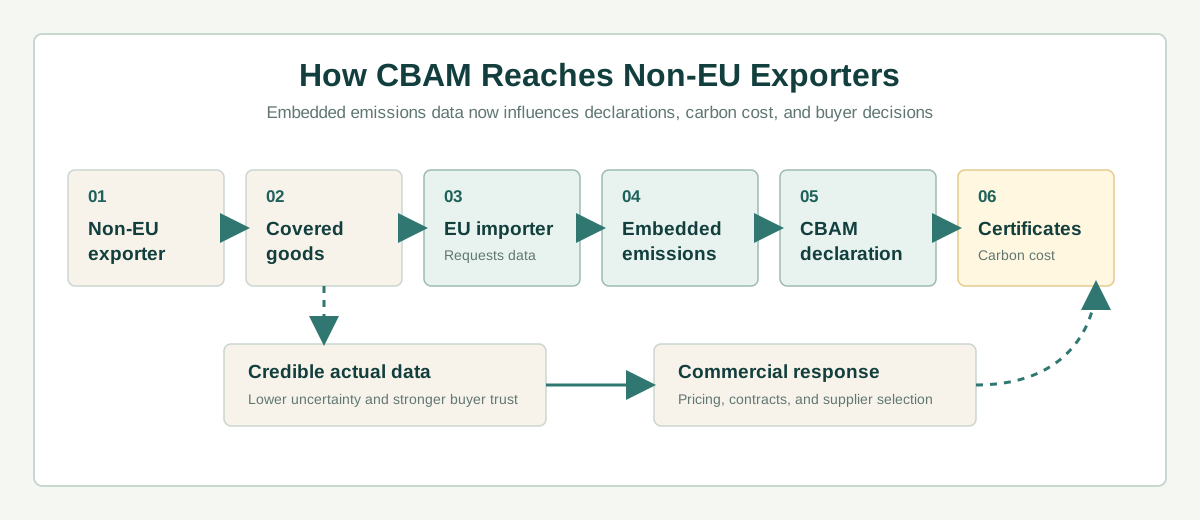
The EU Carbon Border Adjustment Mechanism, or CBAM, is changing how carbon-intensive goods are traded into Europe.
CBAM entered its definitive phase on 1 January 2026. Applicable EU importers must prepare for authorisation, emissions declarations, and certificate surrender. Purchases of certificates for covered 2026 imports begin from February 2027, so the data-collection period and purchase date are different. Source: European Commission. But even though the legal obligation mainly sits with the EU importer, exporters outside the EU are directly affected in practice.
Why? Because importers cannot comply without emissions data from their suppliers.
For exporters, CBAM is no longer just an EU climate policy. It is becoming a customer requirement, a pricing factor, and a new form of trade competitiveness.
Which products are covered?
CBAM currently applies to selected goods in six sectors:
- Cement
- Iron and steel
- Aluminium
- Fertilisers
- Electricity
- Hydrogen
For most exporters, the biggest practical exposure is likely to come from iron and steel, aluminium, fertilisers, and related industrial supply chains. Companies should check the applicable CN codes rather than relying only on broad sector names.
How CBAM affects exporters
CBAM can affect exporters in several ways:
- EU customers may ask for detailed embedded-emissions data.
- Contracts may include CBAM-related data clauses.
- High-carbon products may become less price-competitive.
- Verified actual emissions may become commercially valuable.
- Suppliers with poor data may be replaced by better-prepared competitors.
- Carbon performance may become part of procurement scoring.
In short, CBAM turns carbon data into a trade requirement.
The cost impact
CBAM certificate prices are linked to EU ETS allowance prices. In 2026, the European Commission publishes quarterly certificate prices. The published prices cited for the first two quarters are:
- Q1 2026: EUR 75.36 per tCO2
- Q2 2026: EUR 75.28 per tCO2
The cost is paid by the EU importer, but exporters may still feel the impact through price negotiations. A buyer may ask:
- Can you provide actual emissions data?
- Can you prove it with documentation?
- Are your emissions lower than default values?
- Can you reduce the embedded carbon over time?
- Should the CBAM cost be reflected in the purchase price?
This is why exporters should not treat CBAM as only the importer's problem.
The data impact may be bigger than the tax
For many exporters, the hardest part is not the carbon price itself. It is the data system behind it.
EU buyers may request:
- Facility-level production data
- Fuel and electricity consumption
- Raw material and precursor data
- Direct emissions calculations
- Relevant indirect emissions information
- Emission factor sources
- Production route details
- Supporting invoices, meter records, and technical documents
- Verification reports where actual emissions are used
This is much more detailed than a general ESG statement. It requires structured, traceable, audit-ready carbon data.
Actual emissions vs. default values
Exporters should pay close attention to the difference between actual emissions and default values.
If an exporter cannot provide reliable emissions data, the EU importer may rely on default values. These may not reflect the exporter's real performance.
For companies that have already invested in cleaner electricity, efficient equipment, recycled inputs, or lower-carbon production routes, verified actual emissions can become a competitive advantage.
The key question is not only:
Can we calculate our emissions?
It is:
Can we prove our emissions in a way that EU customers and verifiers can accept?
What exporters should do now
1. Check product scope
Start with product codes. Confirm whether your exported goods fall under CBAM-covered CN codes.
2. Identify affected customers
List EU customers and importers who may need CBAM data from you.
3. Map production boundaries
Understand which facility, process route, raw materials, fuels, electricity, and precursors are involved in producing the exported goods.
4. Build a CBAM data pack
A PCF report does not replace a CBAM-specific calculation or declaration. Reuse compatible energy, material, and production records only after checking the applicable CBAM boundary, period, precursor treatment, and verification requirements. See the Commission's calculation and verification rules.
Prepare a repeatable package including:
- Product information
- Installation information
- Activity data
- Emission factors
- Calculation method
- Assumptions
- Supporting evidence
- Verification status
5. Compare actual emissions with defaults
If your actual emissions are lower than default values, this may help reduce your customer's CBAM exposure.
6. Prepare for verification
Where actual emissions are reported under CBAM, the relevant data and calculations should be prepared for verification under the applicable rules. Exporters should organize internal records before customer deadlines arrive.
7. Use CBAM to drive reduction
CBAM should not be only a reporting exercise. Use the data to identify emission hotspots and improve production efficiency.
Common mistakes to avoid
Exporters should avoid:
- Waiting until the customer asks for data
- Providing different numbers to different buyers
- Using company-wide averages when facility-level data is needed
- Ignoring documentation and audit trails
- Assuming carbon-neutrality claims can replace CBAM calculations
- Treating CBAM as a one-time compliance task
- Overlooking future scope expansion and anti-circumvention rules
The bigger message
CBAM is part of a larger shift in global trade.
Export competitiveness is no longer based only on price, quality, and delivery. For carbon-intensive goods, it increasingly depends on whether a company can measure, prove, and reduce the emissions embedded in its products.
For exporters selling to the EU, carbon data is becoming part of trade infrastructure.
The companies that prepare early will be better positioned to:
- Respond quickly to EU customer requests
- Reduce pricing uncertainty
- Protect market access
- Strengthen buyer trust
- Turn lower-carbon production into a commercial advantage
CBAM is often described as a carbon border cost. But for exporters, it is also a signal: the next generation of global trade will reward companies that can make carbon performance visible, verifiable, and manageable.
Sources
Climate Seal Resources
Do you find our content useful? Get updated once a week
Receive a concise weekly digest of new articles, regulatory insights, and practical guidance.

