How AI Could Transform Carbon Accounting, and Where General AI Still Falls Short
Carbon accounting is often described as a calculation problem. In practice, calculation is only one part of the work.
Consultants and sustainability teams spend significant time interpreting regulations, requesting data, cleaning spreadsheets, researching emission factors, documenting assumptions, checking inconsistencies and preparing reports. Much of this work is structured enough for AI to support, but contextual enough to consume substantial human time.
General-purpose AI tools such as ChatGPT, Claude, Gemini and coding agents can already change this workflow. The opportunity is not simply to write reports faster. It is to redesign how carbon accounting work is performed.
Where general AI can help today
1. Understanding regulations and methodologies
AI can summarize standards, compare regulatory requirements and translate technical language into practical checklists. For example, it can help identify differences between the GHG Protocol, ISO 14064, ISO 14067, CBAM and sector-specific product rules.
The limitation is reliability. AI may use outdated information, overlook exceptions or combine requirements from different regulatory versions. Every material interpretation must therefore be checked against the original source.
2. Preparing client data requests
AI can turn a project scope into questionnaires, data templates and follow-up emails. It can also tailor requests to different departments, facilities or suppliers.
However, generic AI may request too much information, miss sector-specific data or fail to distinguish mandatory inputs from useful supporting information. Consultants still need to determine what is materially relevant.
3. Cleaning and structuring data
AI can help standardize supplier names, classify purchasing records, detect missing units, convert file formats and write scripts for repetitive spreadsheet work. Coding tools can be especially useful when thousands of rows must be processed consistently.
But AI can silently misclassify records or apply incorrect conversions. Any automated transformation should preserve the original data, document the applied rules and produce an exception list for review.
4. Researching emission factors
AI can identify potential factor sources and compare their geography, year, technology and system boundaries. This can significantly accelerate the research process.
This is also one of the highest-risk applications. General AI may invent factors, cite inaccessible sources or return a valid number with the wrong unit, year or boundary. It should be used to find and evaluate candidates, not as the emission-factor database itself.
5. Supporting calculations and quality checks
AI can write formulas or code, identify possible double counting, flag unusual values and compare results across facilities or reporting periods. It can act as a useful second reviewer.
However, language models are not inherently deterministic calculation engines. Complex calculations should run in spreadsheets, databases or tested code. AI can build and inspect the logic, but the numerical process must remain reproducible.
6. Drafting reports and client communications
Once calculations and assumptions are confirmed, AI can prepare methodology descriptions, executive summaries, data-gap explanations and client presentations. It can also adapt the same findings for technical and non-technical audiences.
The risk is that polished language can hide weak evidence. AI-generated text may sound more certain than the underlying data allows. Every statement must remain connected to its calculation, assumption and source.
The broader limitations of general AI
General AI has several structural limitations in professional carbon accounting:
- It may hallucinate regulations, factors or references.
- Its answers can change between runs.
- It does not automatically maintain a complete audit trail.
- It may lose context across large datasets and long projects.
- It cannot independently determine whether evidence is sufficient for assurance.
- Uploading sensitive company data may create confidentiality and governance risks.
- It cannot carry professional accountability for the final result.
These limitations do not make general AI unsuitable. They determine where controls and human review must remain.
What an AI-enabled workflow should look like
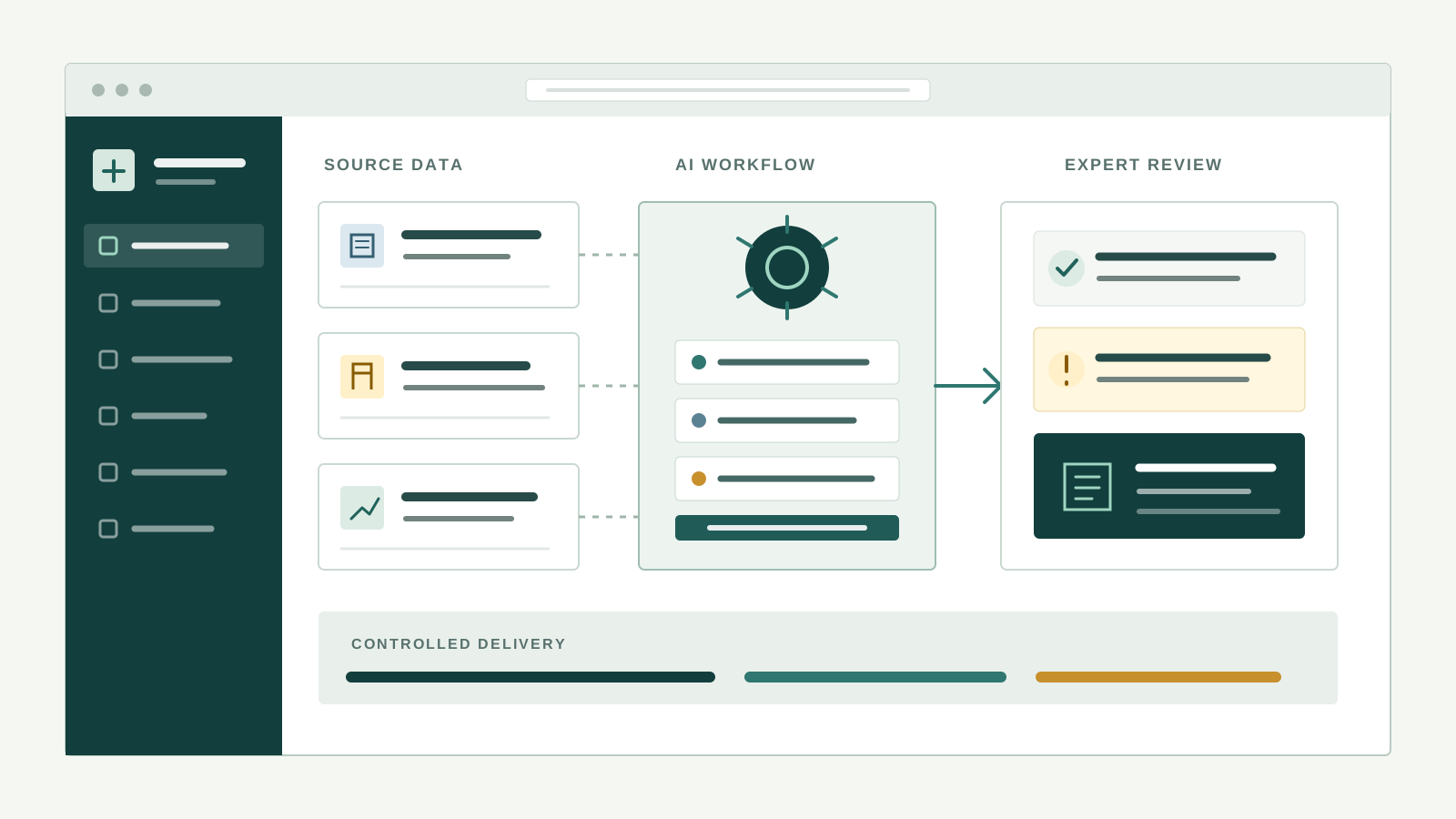
A responsible workflow separates preparation, execution and approval:
- AI preparation: research, extract, structure, draft and check.
- Controlled execution: calculate in reproducible systems and preserve traceability.
- Expert approval: review material assumptions, evidence and conclusions.
The most effective use of AI is therefore not "ask a chatbot to calculate a footprint." It is to place AI around the entire workflow while maintaining controlled data, verified sources, reproducible calculations and explicit review gates.
AI can reduce the time spent searching, formatting and drafting. This allows carbon professionals to focus more attention on boundary decisions, data quality, methodological judgment, reduction strategy and accountability.
The transformation is not that expertise becomes unnecessary. It is that professional value moves away from manually producing every line and toward designing, reviewing and standing behind a reliable result.
The important question is no longer whether AI will be used in carbon accounting. It is whether organizations can use it while preserving evidence, transparency and trust.
Climate Seal Resources
Do you find our content useful? Get updated once a week
Receive a concise weekly digest of new articles, regulatory insights, and practical guidance.