The Future of Product Carbon Labels: What Companies Should Prepare For

Product carbon labels are moving from niche sustainability badges to serious business tools.
For years, many carbon labels were voluntary. A brand could choose to calculate a product footprint, place a carbon label on packaging, or communicate a "carbon neutral" claim as part of its sustainability marketing. But the market is changing. Customers, regulators, investors, and supply-chain partners now want carbon information that is not only visible, but also accurate, comparable, and backed by evidence.
In the next stage, the future of product carbon labels will not be just about adding a symbol to a package. It will be about building a reliable data system behind every claim.
What Is a Product Carbon Label?
A product carbon label communicates the greenhouse gas emissions associated with a product, usually expressed as CO2e, or carbon dioxide equivalent.
Depending on the label, it may show:
- The product's total carbon footprint
- A lower-carbon comparison against similar products
- A verified reduction in emissions
- A carbon neutrality or offset-related claim
- A QR code linking to more detailed product sustainability data
The footprint may cover different life cycle boundaries, such as:
- Cradle-to-gate: from raw materials to the factory gate
- Cradle-to-grave: from raw materials through use and end-of-life
- Cradle-to-cradle: including reuse, recycling, or circular material flows
That boundary matters. A label without a clear boundary can easily mislead customers.
How a Carbon Label Is Built
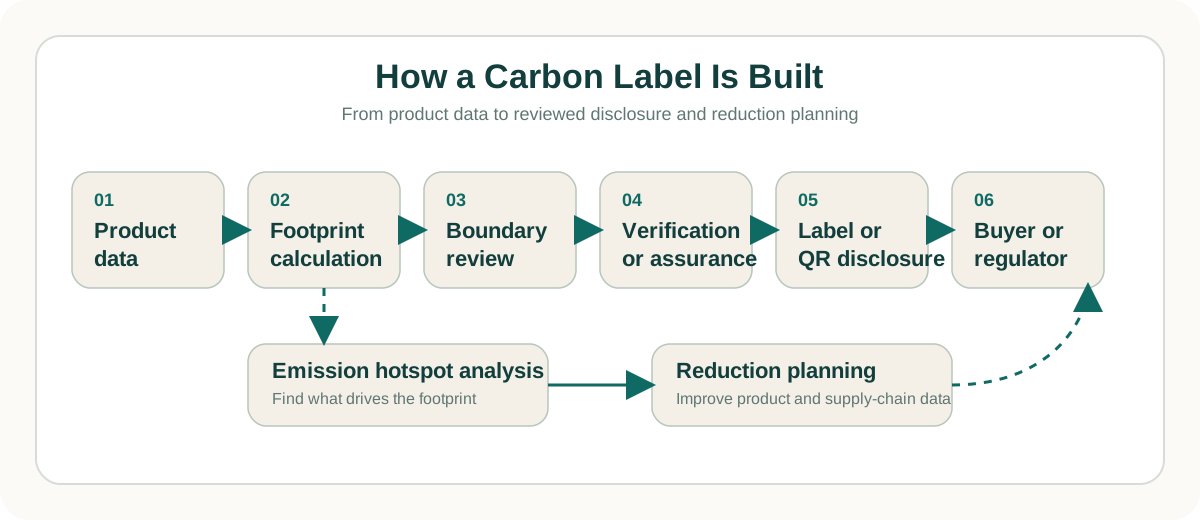
A credible carbon label usually depends on several technical foundations:
- A defined functional unit
- A clear product system boundary
- Reliable activity data
- Appropriate emission factors
- Transparent allocation rules
- Documented assumptions and exclusions
- Review or third-party verification where required
Why Product Carbon Labels Are Becoming More Important
Several forces are pushing product carbon labels into the mainstream.
First, international buyers increasingly need product-level carbon data for Scope 3 reporting and supplier evaluation. A manufacturer may not be legally required to publish a product carbon footprint, but its customer may still request one.
Second, regulators are paying closer attention to environmental claims. In the EU, green claims and sustainability labels are under scrutiny because many claims have been found to be vague, misleading, or unsupported by evidence. The European Commission's Green Claims work highlights the need for environmental claims to be reliable, comparable, and verifiable.
Third, digital product information is becoming more important. Under the EU Ecodesign for Sustainable Products Regulation, technical preparation for Digital Product Passports is already underway. This signals a broader shift from static labels to digital, traceable product information.
Finally, consumers and business customers are becoming more skeptical. Simple words like "green," "eco-friendly," or "carbon neutral" are no longer enough. The future belongs to companies that can explain what they measured, how they measured it, and what they are doing to reduce emissions.
Trend 1: From Simple Logos to Evidence-Based Claims
The next generation of product carbon labels will need stronger evidence.
A good label should answer basic questions:
- What product is being assessed?
- What life cycle stages are included?
- Which standard or method was used?
- What data sources and emission factors were applied?
- Has the result been reviewed or verified?
- Is the company claiming measurement, reduction, comparison, or neutrality?
This is important because a carbon footprint number is not meaningful without context. Two products may show different results simply because they used different boundaries, databases, or assumptions.
Trend 2: From "Carbon Neutral" to "Carbon Accountable"
Carbon neutrality claims are becoming more sensitive, especially when they rely heavily on offsets.
In the past, some companies used carbon credits to support claims that a product was "carbon neutral." Today, that approach faces more legal, reputational, and consumer-trust risk. Many regulators and consumer protection bodies are increasingly concerned that offset-based claims can create the impression that a product has no climate impact.
A safer direction is to focus on carbon accountability:
- Measure the product footprint
- Disclose the methodology
- Reduce emissions in the product and supply chain
- Explain any remaining emissions transparently
- Avoid exaggerated or vague claims
In other words, the strongest future labels may not be the ones that say "zero impact." They may be the ones that clearly show progress, evidence, and reduction.
Trend 3: From Static Packaging to Digital Labels
Future product carbon labels will likely become more digital.
Instead of printing a single number on a package, companies may use QR codes or digital product passports to provide deeper information, such as:
- Product carbon footprint results
- Life cycle boundary
- Materials and components
- Country or facility of production
- Certification and verification documents
- Repair, reuse, or recycling information
- Version history of the footprint calculation
This matters because product data changes. Suppliers change, energy mixes change, production methods change, and emission factors are updated. Digital labels make it easier to keep information current and traceable.
Trend 4: From Generic Methods to Category-Specific Rules
Carbon labels will also become more category-specific.
A fair comparison requires common rules. For example, comparing the carbon footprint of two food products, two batteries, or two textile products requires consistent assumptions about function, lifetime, use phase, packaging, and end-of-life.
Companies should expect more attention to:
- Product category rules
- Product Environmental Footprint methods
- Environmental Product Declarations
- ISO 14067 product carbon footprint principles
- Sector-specific buyer requirements
- Verified supplier data
This is where many companies struggle. The calculation is not just "collect data and multiply by emission factors." The hardest part is often defining what counts, what does not, and how to make the result comparable.
What Companies Should Prepare For
Companies that want to prepare for the future of product carbon labels should start with data readiness.
Key steps include:
- Identify priority products
Start with products that are high-volume, high-emission, strategically important, or frequently requested by customers.
- Map the product life cycle
Understand raw materials, suppliers, manufacturing processes, packaging, logistics, use phase, and end-of-life.
- Choose the right methodology
Depending on the market and customer requirement, this may involve ISO 14067, PAS 2050, the GHG Protocol Product Standard, Product Environmental Footprint methods, or sector-specific rules.
- Build a data collection process
Gather activity data from procurement, production, logistics, energy, packaging, and suppliers.
- Document assumptions clearly
Every footprint contains assumptions. The question is whether they are transparent and defensible.
- Consider verification for external claims
If the result will appear on packaging, websites, product sheets, or customer-facing materials, verification becomes much more important.
- Prepare for digital disclosure
Organize product data in a way that can support QR codes, customer portals, digital product passports, or audit requests.
- Connect labels with reduction plans
A carbon label should not be the end of the work. It should help identify hotspots and guide product improvement.
Common Mistakes to Avoid
Companies should be careful not to:
- Use "carbon neutral" claims without clear explanation
- Compare products calculated with different methods
- Publish a footprint without stating the boundary
- Rely only on generic secondary data when better supplier data is available
- Treat the label as a marketing project only
- Forget to update the footprint when suppliers or production methods change
- Ignore legal review for environmental claims
The biggest mistake is assuming that a carbon label is just a design element. It is actually the visible tip of a much larger carbon data system.
The Future: Labels as Product Passports
The future of product carbon labels is likely to be more transparent, more digital, and more closely connected to supply-chain data.
For consumers, labels may become simpler and easier to understand.
For business buyers, they may become more detailed and evidence-based.
For regulators, they may become part of a broader system for checking environmental claims.
For manufacturers, they will become a new form of product competitiveness.
Companies that prepare early will have an advantage. They will be able to respond faster to customer requests, support credible sustainability claims, reduce greenwashing risk, and identify real opportunities to lower emissions.
The future carbon label will not just say, "This product is green."
It will show the data, explain the method, prove the claim, and point toward improvement.

