CBAM and Chinese Companies: From Compliance Burden to Carbon Competitiveness

As of 2026, the EU Carbon Border Adjustment Mechanism, or CBAM, has moved from a reporting-only transition into its definitive phase. For Chinese companies exporting carbon-intensive goods to Europe, CBAM is no longer just an overseas climate policy to watch. It is becoming a real trade, cost, data, and competitiveness issue.
CBAM mainly affects products in six sectors:
- Cement
- Iron and steel
- Aluminium
- Fertilisers
- Electricity
- Hydrogen
For China, the most relevant sectors are likely to be steel, aluminium, fertilisers, and downstream industrial goods that use carbon-intensive materials.
What Is CBAM?
CBAM is the EU’s carbon border policy. Its purpose is to put a carbon price on certain imported goods so that producers outside the EU face a carbon cost similar to producers inside the EU Emissions Trading System.
In simple terms:
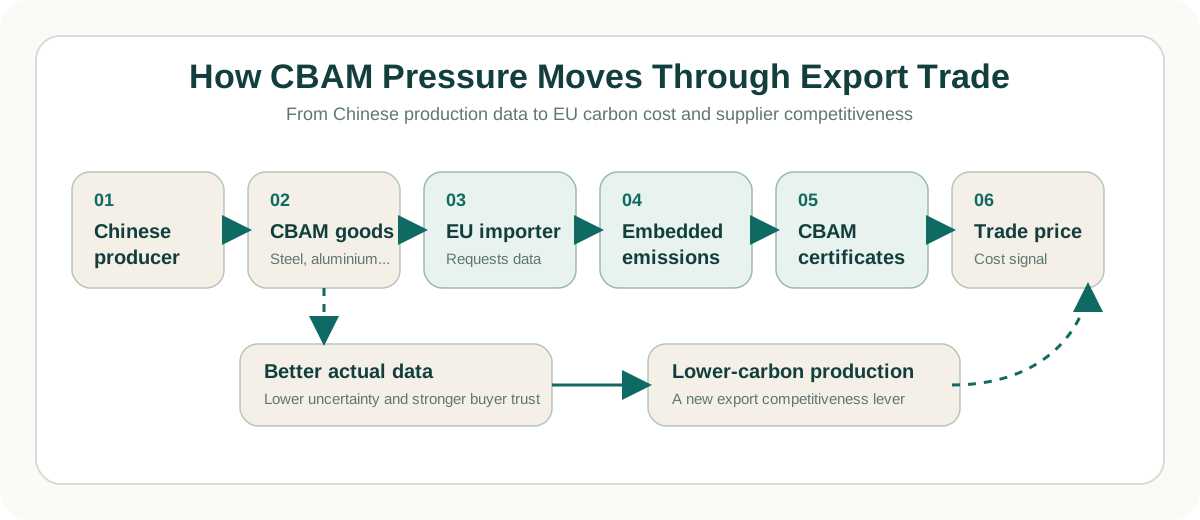
Legally, the main CBAM obligation falls on the EU importer or its indirect customs representative. But in practice, the importer will need emissions data from the Chinese producer. That means Chinese exporters will still feel the impact through customer requests, pricing pressure, contract terms, and verification requirements.
Why CBAM Matters to Chinese Companies
CBAM changes the logic of export competitiveness.
In the past, price, quality, delivery time, and production scale were often the main factors in supplier selection. Under CBAM, embedded carbon emissions become another commercial variable.
A Chinese supplier with lower emissions and better data may become more attractive to EU buyers. A supplier with poor data or high emissions may face:
- More customer questionnaires
- More requests for verified emissions data
- Higher indirect carbon costs
- More difficult price negotiations
- Risk of being replaced by lower-carbon suppliers
- Pressure to disclose production routes, energy sources, and emission factors
CBAM therefore turns carbon management from an ESG topic into a market access and sales competitiveness issue.
The Cost Impact: Carbon Becomes Part of Export Pricing
From 2026, EU importers must buy CBAM certificates for the embedded emissions in covered imports. The CBAM certificate price is linked to the EU ETS allowance price.
According to the European Commission, the CBAM certificate prices published so far in 2026 were:
- Q1 2026: EUR 75.36 per tonne CO2
- Q2 2026: EUR 75.28 per tonne CO2
This does not mean every product will automatically face this exact cost. The final financial impact depends on:
- Product category
- Quantity imported
- Embedded emissions
- Applicable CBAM methodology
- Whether actual verified emissions are used
- Whether any eligible carbon price has already been paid in the country of production
- Commercial negotiation between exporter and importer
But the direction is clear: higher embedded emissions can translate into higher trade costs.
The Data Impact: Buyers Will Ask for More Evidence
For many Chinese companies, the bigger challenge may not be the certificate cost itself, but the data work behind it.
EU importers need product- and installation-level emissions information. Chinese exporters may be asked to provide:
- Production process data
- Fuel and electricity consumption
- Raw material inputs
- Emission factor sources
- Direct emissions calculations
- Relevant indirect emissions data
- Monitoring methodology
- Verification documents
- Facility-level evidence
This is a different level of detail from traditional sustainability reporting. It is closer to audit-ready carbon accounting.
Companies that still manage carbon data in scattered spreadsheets may find CBAM difficult. Companies that build a structured product carbon data system will be in a stronger position.
Actual Data vs. Default Values
One important point for Chinese exporters: better data can have commercial value.
If a company cannot provide reliable actual emissions data, the importer may need to rely on default values or conservative assumptions. These may not reflect the supplier’s real performance, especially if the company has already invested in cleaner energy, efficient equipment, recycled inputs, or lower-carbon production routes.
For lower-emission suppliers, using actual verified emissions can help show that their products deserve a lower CBAM liability than generic estimates.
So the question is no longer only:
“Can we calculate our emissions?”
It becomes:
“Can we prove our emissions in a way that our EU customers and verifiers can accept?”
Which Chinese Companies Are Most Exposed?
CBAM exposure is highest for companies that:
- Export covered goods directly to the EU
- Supply EU importers with steel, aluminium, fertilisers, cement-related products, hydrogen, or relevant precursors
- Operate energy-intensive production processes
- Depend heavily on coal-based electricity or high-carbon fuels
- Sell to European manufacturers with strict supplier carbon requirements
- Lack verified facility-level emissions data
Even companies that do not directly export to Europe may still be affected if they supply intermediate materials to exporters. CBAM pressure can move upstream through the supply chain.
Strategic Impact: Low-Carbon Suppliers Gain an Advantage
CBAM is often described as a “carbon tariff,” but for companies it is also a market signal.
It rewards suppliers that can:
- Measure emissions accurately
- Reduce energy intensity
- Use lower-carbon electricity
- Increase recycled material content where accepted by methodology
- Improve process efficiency
- Maintain traceable production data
- Support third-party verification
- Communicate clearly with EU buyers
Over time, carbon performance may become part of supplier scoring. A low-carbon Chinese manufacturer may be able to use CBAM readiness as a selling point.
What Chinese Companies Should Do Now
Chinese exporters should prepare in five practical steps.
1. Check Whether Products Are in Scope
Start with HS/CN codes and confirm whether exported products fall under CBAM-covered categories. Do not rely only on broad sector names.
2. Map the Production Boundary
Identify which facility, process route, raw materials, fuels, electricity, and precursors are involved in producing the exported goods.
3. Build a CBAM Data Pack
Prepare a repeatable data package for EU customers, including calculation methodology, activity data, emission factors, assumptions, and supporting evidence.
4. Compare Actual Emissions With Defaults
If actual emissions are lower than default assumptions, verified data may help reduce the commercial burden.
5. Turn Compliance Into Reduction
Use CBAM calculations to identify hotspots: electricity, fuel, process emissions, raw materials, or logistics. The best long-term response is not only better reporting, but lower emissions.
Common Mistakes to Avoid
Chinese companies should avoid:
- Treating CBAM as only the EU importer’s problem
- Waiting until customers request verified data
- Providing inconsistent figures to different buyers
- Using corporate-level averages when facility-level data is needed
- Ignoring documentation and audit trails
- Assuming “carbon neutral” claims can replace CBAM calculations
- Underestimating future scope expansion
The EU has already signaled continued attention to downstream goods and anti-circumvention safeguards, so CBAM readiness should be treated as a long-term capability.
Conclusion
CBAM creates new pressure for Chinese companies, especially exporters in steel, aluminium, fertilisers, cement-related goods, hydrogen, and other carbon-intensive supply chains.
But it also creates an opportunity.
Companies that prepare early can respond faster to EU customer requests, reduce pricing uncertainty, protect market access, and turn carbon data into a competitive advantage. In the CBAM era, the winning suppliers will not simply be the cheapest. They will be the ones that can prove what their products are made of, how they are produced, and how much carbon is embedded in them.
For Chinese companies exporting to Europe, carbon accounting is becoming part of trade infrastructure.